

The hiking route to the citadel is the most popular and well-known among travelers. The hike has a total distance of approximately 43 kilometers and takes 4 days, including the most awaited moment: the visit to the Archaeological Park of Machu Picchu. Also, the nature of the area is simply wonderful, with impressive views of snowy mountains, and the journey through the high jungle, where you can see different archaeological remains. Therefore, having an Inca Trail Map is essential to understand the scale of this adventure.
The Inca Trail to Machu Picchu is without a doubt, one of the most sought-after excursions on a trip through Peru, as its spectacular landscapes in the Andes range show a mix of jungle and mountain. No other known circuit crosses so many changing ecological levels, constantly accompanied by imposing snowy peaks, crystal clear rivers, and exuberant flora and fauna.
This tour can start at the route points known as km 82, 88, and 104. At km 82 or 88 you arrive by train service, just like at km 104, which is the start of the Short Inca Trail route.
Key points to understand the route on the map
- Variety of Starts: Depending on the operator or the permit obtained, your adventure can start at different altitudes and landscapes.
- Railway Logistics: Coordination with the train is vital; for this 2026, stops at the starting kilometers are strictly scheduled for groups with valid permits.
- Ecosystems: The map will show you how you will go from the Andean dryness to the humidity of the cloud forest in just a couple of days.
The Classic Inca Trail (4 days)
The Inca Trail to Machu Picchu, in its 4 day version, is highly recognized as one of the best hikes, and for good reason; its value lies both in its historical legacy and in the breathtaking beauty of its surroundings. When checking the Inca Trail Map, you will notice that this route is a geographical journey that covers opposite ecological zones: from the high plateau to the humidity of the Andean tropical forests.
Following this ancient road system, known as Qhapaq Ñan, means crossing mysterious archaeological sites that appear among the mist and settings covered in wild vegetation. Therefore, every step is a preparation to cross the Sun Gate (Inti Punku) just in time to enjoy the first and most exciting panoramic view of the lost city of the Incas, Machu Picchu.
Key data you will see on the map
For your planning in this 2026, these are the technical milestones you must identify:
- Total distance: Approximately 43 km.
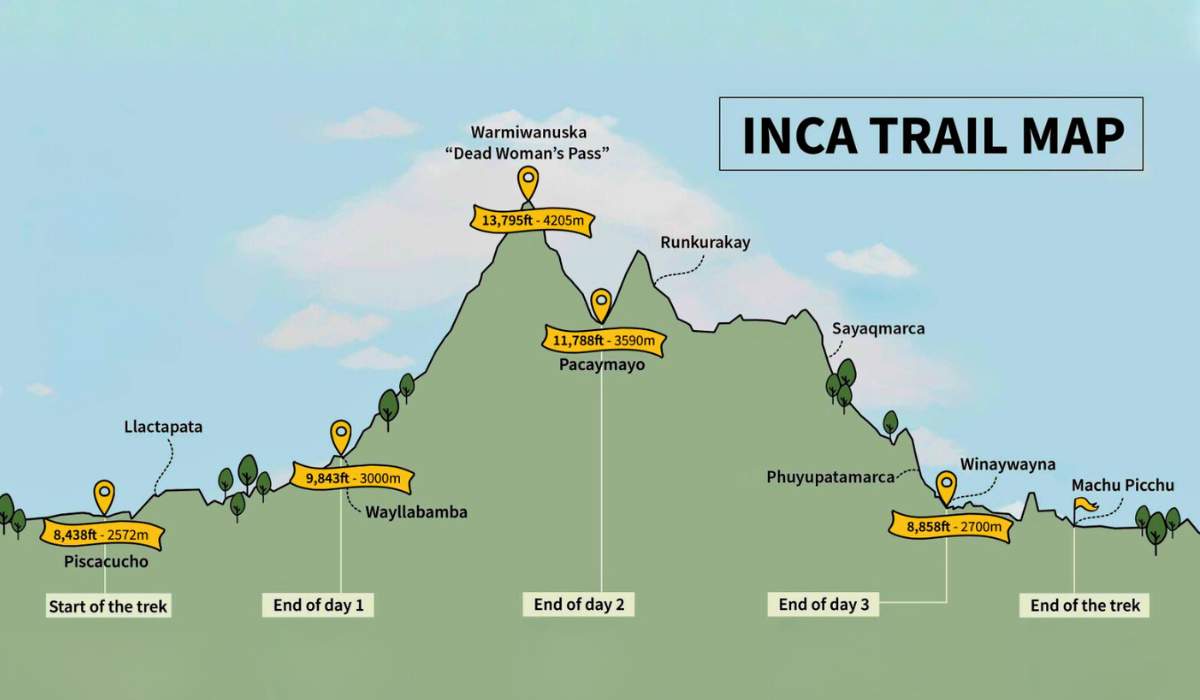
- Highest point: The imposing Dead Woman’s Pass (Warmiwañusca), located at 4,215 masl.
- Start: Km 82 (Piscacucho), the start of this adventure.
- End: Machu Picchu, entering triumphantly through the Sun Gate.
Classic Inca Trail Itinerary – 4 Days
This trip is much more than a simple hike; it is a journey through the geography that was once traveled by the Incas. Throughout four days, the map will guide you through ancient paths, Inca archaeological sites, and some of the most impressive landscapes of Peru.
Day 1: The start of the hike
The Classic Inca Trail begins in the city of Cusco, from where travelers go by bus to Km 82 (Piscacucho). Once at the checkpoint, after registering the corresponding permits, the adventurers adjust their backpacks to start the great adventure to Machu Picchu at an altitude of 2,650 masl.
The climb during this first day is ideal for getting into a rhythm, as it will be gradual and simple. The route takes us slowly up to 3,000 masl, passing first through the Miskay sector (2,800 masl) and ending the day at the Huayllabamba campsite. Moreover, this initial stretch allows you to enjoy the landscape without the pressure of high altitudes, serving as an excellent warm-up for the challenges that will come in the following days.
- Hiking time: 6 to 7 hours on mostly flat ground with light slopes.
- Distance covered: Approximately 11 km.
- Difficulty level: Easy.
Day 2: The challenge of the Warmiwañusca Pass
The second day is, without a doubt, the biggest challenge of the journey, but also one of the most rewarding when checking your Inca Trail Map. The route goes through narrow and steep paths that test the endurance of every traveler. For about 9 km of steady climb, we will walk toward the highest point of the whole trip: the top of the Warmihuañuska peak (Dead Woman’s Pass), located at an imposing 4,215 masl.
Once the summit is reached and after catching your breath with the spectacular views of the mountain range, we will start to go down to the Pacaymayo campsite, located at 3,600 masl. This day requires all your focus and a steady pace; the physical effort is significant, but the high mountain landscape is one of the best you can see.
- Hiking time: 8 hours approximately (depending on pace and stops).
- Distance covered: 15 km approximately.
- Difficulty level: Difficult.
Day 3: Between landscapes and ruins
The third day is, for many, the most beautiful and fascinating of the entire journey. The hike starts with a slight climb from Pacaymayo, marking the beginning of a more difficult section that lasts about an hour until reaching the Runkuracay archaeological site (3,750 masl). From this ancient lookout post, we will begin a descent toward the mystical Yanacocha lagoon, and then start a new climb toward Phuyupatamarca, known as the “place above the clouds.”
Finally, the route takes us through an excursion across flatter ecosystems and paths carved into the rock that go through the cloud forest, until reaching the impressive site of Wiñay Wayna.
- Hiking time: 7 to 8 hours approximately.
- Distance covered: 10 km approximately.
- Difficulty level: Difficult (due to the level changes and the sections of stairs).
Day 4: The Encounter with the Lost City
The last day of adventure is the most awaited and, fortunately, the easiest in terms of physical effort. The day starts very early, in the dim light of the cloud forest, with a short final climb toward the Inti Punku or Sun Gate.
From the Sun Gate, we will begin a gentle and triumphant descent toward the archaeological site of Machu Picchu. Furthermore, walking along these final paths, seeing how the clouds clear away to reveal the buildings of the Inca citadel, is a visual and emotional experience. Therefore, this final stretch is not just a physical journey, but the end of a pilgrimage to one of the wonders of the modern world.
- Hiking time to Machu Picchu: approximately 3 hours.
- Distance covered: approximately 7 km.
- Difficulty level: Moderate.
Classic Inca Trail Map
Short Inca Trail (2 Days)
This short version of the legendary path is ideal for travelers with little time who still want the magic of reaching the citadel on foot. This route offers an amazing mix of landscapes in less time, allowing you to enjoy the change between the Andean mountains and the high jungle, an ecosystem famous worldwide for its variety of orchids and exotic birds.
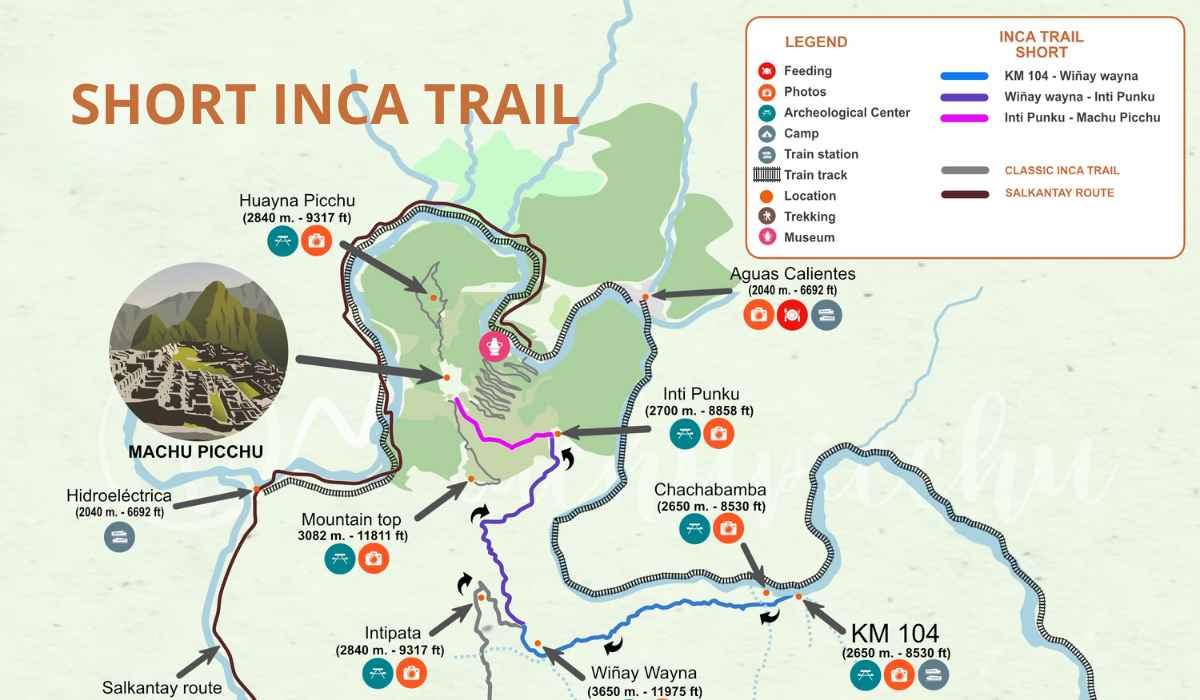
The route starts at kilometer 104 and features a steady but rewarding climb. On the map, the journey connects key archaeological sites with amazing views of both the Sacred Valley and the Peruvian Amazon:
- Chachabamba (2,200 m): The first discovery on the map, located on the banks of the Urubamba River. It is a site historically dedicated to water worship.
- Wiñay Wayna (2,650 m): Considered by many as the most beautiful site on the entire path. Its name means “Forever Young” and it clings amazingly to a steep slope before the final stage.
- Inti Punku (2,720 m): The famous Sun Gate, where you will have the first and most striking panoramic view of Machu Picchu (2,490 m) at sunset.
Key facts you will see on the map:
- Total hiking distance: Approximately 12 km on the first day.
- Highest point: Inti Punku (2,720 m).
- Start: Km 104 (Chachabamba).
- Difficulty: Moderate (due to the steady climb, but short in length compared to the classic route).
Short Inca Trail itinerary – 2 days
This option is perfect for those who want to experience the essence of the Qhapaq Ñan without the demand of four days of camping. On this trip, the Inca Trail Map unfolds before us in an intensely beautiful version full of history.
Day 1: Cusco – Wiñayhuayna – Machu Picchu
Our adventure begins with the transfer from the city of Cusco to Km 104. This 11-kilometer hike during the first day will allow you to see and learn closely about one of the most important cultures in South America: the Inca, Quechua, or Andean culture.
Between the peaks and the tropical jungle, we will move along a magnificent path that winds through the Sacred Valley. The first archaeological site we will visit is Chachabamba (2,200 m), strategically located on the banks of the Urubamba River. From there, we will begin the climb toward Wiñaywayna (2,650 m), a complex that seems to float on the top of the mountain. Finally, we will head to Intipunku (2,720 m), the iconic Sun Gate, where you will see the panoramic view of Machu Picchu (2,490 m). Throughout the journey, you will be able to see a great variety of exotic birds and the lush flora and fauna of the cloud forest.
- Hiking time: Approximately 6 to 7 hours until reaching the Sun Gate.
- Visual experience: Unlike the classic route, here you will enjoy the citadel with the warm light of the sunset before descending to the town of Aguas Calientes.
Day 2: The Citadel of Machu Picchu
After having a first visual encounter from the Sun Gate the day before, today we dedicate ourselves completely to exploring the citadel of Machu Picchu, one of the most spectacular and mysterious cities of the ancient world. Upon waking up in the town of Aguas Calientes, we will take the bus that will take us back to the top of the mountain to discover the secrets that this World Heritage Site keeps.
Built under the command of the Inca Pachacútec in the 15th century, this fabulous city is a masterpiece of urban planning and engineering. During the tour, we will walk through its agricultural and urban sectors, which house homes, sacred temples, storehouses, and an imposing main square. The whole complex is perfectly connected by narrow streets and stairs of carved stone. Also, you can admire how the city is surrounded by impressive terraces, which not only served for agriculture but also acted as a sophisticated support system for the mountain.
Points of interest for your visit
- The Temple of the Sun: Observe the perfection of the stonework in this semi-circular structure dedicated to the most important deity of the Incas.
- The Intihuatana: The famous solar clock that served to measure solstices and equinoxes, a sign of advanced Andean astronomical knowledge.
- The Sacred Rock: A monolith that copies the silhouette of the surrounding mountains, reminding us of the spiritual connection of the Incas with nature.
Short Map of the Inca Trail
Alternative routes to Machu Picchu
Besides the famous traditional Inca Trail, there are alternative routes that lead to the citadel and offer truly unique experiences. These hikes in Cusco are ideal for those travelers looking for a different route, a closer contact with nature, and a greater variety of Andean landscapes, from imposing glaciers to cloud forests. Among the most recommended and fascinating options are:
- Lares Trek to Machu Picchu (4 Days): Known as the “Cultural Route,” where you can interact with local communities and learn about their textile traditions.
- Salkantay Trek (4 Days to Machu Picchu): The most popular alternative for lovers of adventure and high mountain landscapes.
- Llactapata Inca Trail to Machu Picchu: A route that offers a unique and rare view of the sanctuary from the nearby mountains.
- Huchuy Qosqo Hike (2 days): A short but intense journey that visits an archaeological complex hanging over the Sacred Valley.
- 2 day Inca Trail with camping: A variation of the short trail that allows you to enjoy the experience of sleeping under the stars before seeing the citadel.
- Huchuy Picchu Mountain: A shorter and newer hiking option, ideal for getting quick aerial views of the main site.
If you wish to visit Machu Picchu in this 2026, we strongly recommend booking your “Machu Picchu Entry Tickets” well in advance. Due to high demand and capacity limits to preserve the site, securing your tickets and permits early is the only way to ensure you enjoy your “Machu Picchu Vacations” without any problems and can live a unique experience.