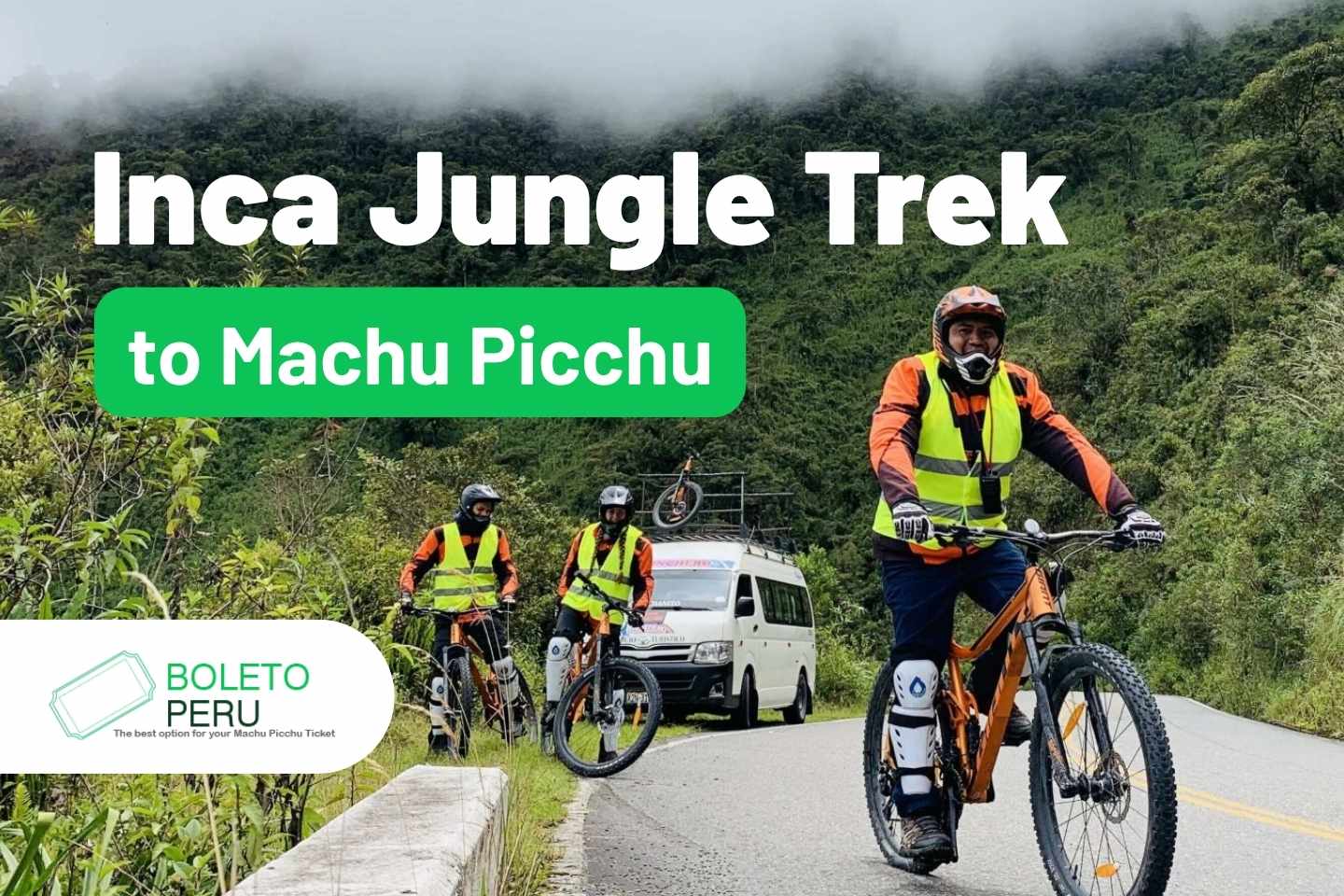
Do you know how to get to Machu Picchu in an entertaining way? The Inca Jungle Trek is one of the best answers. It is four days that combine a downhill bike ride from an altitude of 4,300 meters, rafting on the Urubamba River, walking along a section of the Inca Trail, relaxing in hot springs, zip-lining over the valley, and, at the end, arriving at the citadel. Each day changes landscape, rhythm, and temperature, making the trip feel like much more than just a tour.
What sets this route apart is precisely that it is not a classic trek. Here, it is not about walking for days with a heavy backpack and a single goal in mind, but about covering a multi-adventure path that goes down from the high Andean plain, cold and open, to the high jungle, humid and full of greenery. The changes in weather, plants, and scenery are constant, and each activity shows you the land from a different angle. Is it for you if you are not an experienced trekker? Many travelers looking for something more dynamic than the traditional walk answer yes, and you will learn why.
In this blog, you will find everything you need to plan your own experience: the day-by-day route, the places visited along the way, approximate costs, the real difficulty level of each stage, and a comparison with other treks to Machu Picchu so you can decide which one best fits your travel style. Ready to start coming down from 4,300 meters? Let us go step by step.
What is the Inca Jungle Trek?
The Inca Jungle Trek is an alternative adventure route to Machu Picchu that combines mountain biking, rafting (optional), trekking, and zip-lining. Unlike the classic Inca Trail, here you do not need advance permits or to carry all your gear for days, because the activities are split between transport sections, accommodations, and walks of moderate difficulty. The trip goes from the Abra Malaga area, in the high Andean plain, to Aguas Calientes, in the high jungle, and ends with a visit to the citadel.
Quick sheet
| Data | Detail |
|---|---|
| Duration | 3 to 4 days (the classic version takes 4 days / 3 nights) |
| Approximate Distance | About 55 km by bike and between 30 and 40 km on foot |
| Maximum Altitude | Approx. 4,300 m (Abra Málaga, start of the bike descent) |
| Minimum Altitude | Approx. 1,400 m (Santa María area) |
| Difficulty | Moderate. Does not require technical experience, but good physical condition is needed |
| Best Season | May to September, during the dry season (less rain and better trail conditions) |
| Traveler Profile | Active adventurers, travelers looking for an alternative to the classic trek, and groups seeking variety |
Available versions
- Inca Jungle Trek 3 days / 2 nights. It is the most compact and budget-friendly option. It condenses the activities into less time, with longer days and less rest in between.
- Inca Jungle Trek 4 days / 3 nights. It is the most popular and the one recommended by most agencies. It spreads the activities out more calmly, leaves time for the hot springs, and allows you to arrive at Machu Picchu in better spirits.
- Inca Jungle Trek via Llactapata. Instead of following the usual route to Aguas Calientes, this alternative goes up to the archaeological site of Llactapata, from where you get a different view of Machu Picchu.
- 7 day extensions. Some agencies combine the Inca Jungle Trek with other southern Andean destinations. The two most common are:
- With Lake Titicaca: Adds a cultural and high-altitude portion in Puno.
- With Rainbow Mountain (Vinicunca): Adds a day of hiking at over 5,000 meters, so it is best to arrive well-acclimated.
Map and elevation profile
Before going into the detail of each day, it is helpful to look at the full route. The path starts from Cusco (≈3,400 m), goes up to Abra Málaga (≈4,316 m), the highest point of the trip, and from there begins a long descent toward Santa María (≈1,430 m). Then it continues through Santa Teresa (≈1,500 m) and Hidroeléctrica to reach Aguas Calientes (≈2,040 m) and, finally, Machu Picchu (≈2,430 m).
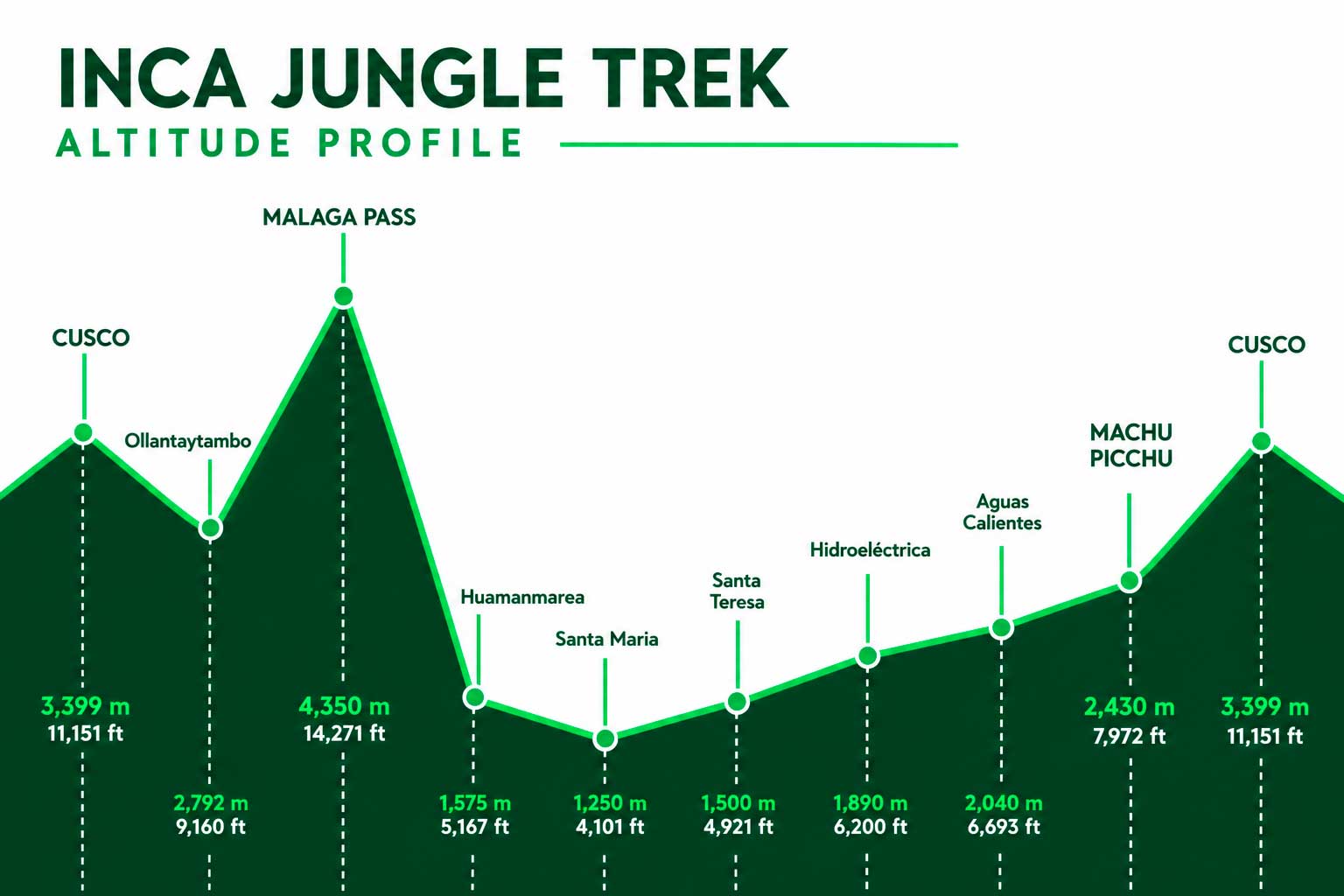
The most striking feature is the descent: in just two days, you go down more than 2,800 meters. That means going from the cold and wind of the high Andean plain to a warm, humid jungle climate, with changes in vegetation, temperature, and even clothes along the way. That is why it is best to wear layers: warm clothes and gloves for the start on the bike, and lightweight clothes and insect repellent for the following days.
Travel itinerary: Inca Jungle Trek
The four-day Inca Jungle Trek is a route that gradually goes down from the cold high plain to the high jungle, and in each stage, the landscape, weather, and type of activity change. It begins with a bike descent from the heights of Abra Málaga, winding through sharp turns, waterfalls, and views of Mount Verónica. Then comes the moment to decide whether to add river rafting, an option that those looking for more adrenaline usually enjoy.
From there, the journey moves to your feet: you walk along an authentic section of the Qhapaq Ñan, pass through coffee, coca, and fruit farms, and make stops to rest in hammocks and learn about local life. After so much effort, the Cocalmayo hot springs are the perfect reward to relax your body. Later, those who want more action can go zip-lining over the canyon, and those who prefer a different view of the citadel can choose the Llactapata variation. The final stretch is done along the train tracks to Aguas Calientes, the base town for visiting Machu Picchu. Below, we will tell you about each day in more detail, including what to do, what to see, and what to keep in mind:
Day 1: Cusco – Abra Málaga – Santa María
Pick-up is usually around 6:00 a.m. at your hotel. The road goes through the Sacred Valley and stops for breakfast in Ollantaytambo, a good time to meet the group and the guides before heading up. The bus ascends to Abra Málaga, the highest point of the trip; it is cold here, so it is wise to put on warm layers, gloves, and a windbreaker before setting off.
Upon reaching the starting point of the Inca Jungle Trek, you are given a helmet, protective gear, and the bicycle, and the guide gives a safety talk. Then, you ride down the road on asphalt and some dirt sections, with sharp turns, waterfalls, and a change of ecosystems. It is worth noting that along the way there is a small Inca site that serves as a stop to stretch your legs and get historical context for the route. Afterward, the group has lunch.
Upon arriving in Santa María, those who wish to can go river rafting, with class 3 to 5 rapids depending on the section and season, for an extra cost of ≈USD 45. Those who prefer not to paddle can rest or explore the town. On the other hand, the first night is spent in simple lodging in the high jungle, with a shower, dinner, and dry clothes, which are much appreciated after an intense day.
Day 2: Santa María – Qhapaq Ñan – Cocalmayo – Santa Teresa
This second day is the most demanding and starts with a steep climb that tests your body and patience. Here you walk along an authentic section of the Inca trail that connected this area with Vilcabamba; the path is stone-paved, narrow, and offers views of the valley, making it usually one of the most memorable moments of the route. Can you imagine walking the very same path used by the chasquis centuries ago?
Along the way, there are stops at local homes and farms, featuring hammocks, fresh fruit, and explanations from the guide about the use of coca and the growing of coffee. It is a break that brings local culture to the day. The day ends with a soak in the Santa Teresa hot springs, surrounded by plants, ideal for relaxing your legs and back. You arrive in town, have dinner, and sleep. It is a simple and quiet place, with shops and a bit of nightlife.
Day 3: Santa Teresa – Hidroeléctrica – Aguas Calientes
For this third day, you can go zip-lining over the Urubamba River canyon, which is an optional but very fun activity. For this sport, it is standard to have a harness, helmet, gloves, and a team that checks each section before you launch. If you are afraid of heights, you can watch the first stretch and decide as you go.
On the other hand, there is the Llactapata variation, where those who choose this alternative hike up through Lucmabamba to the ruins of Llactapata, from where you can see Machu Picchu head-on and in the distance. It is a longer route with more elevation change, but it offers a different view and a quieter atmosphere than the classic route.
In the afternoon, you start the journey through Hidroeléctrica, the meeting point for the group and the place where lunch is served before the final walk following the train tracks until reaching Aguas Calientes, with the river on one side and the jungle on the other. Afterward, you arrive in Machu Picchu Pueblo (Aguas Calientes), check into your hotel, and receive the briefing from the guide with the schedule and details for the next day. It is a good time to have a relaxed dinner and go to sleep early.
Day 4: Machu Picchu
The last day of this Inca Jungle Trek experience is for visiting the citadel of Machu Picchu. But to get to the site, there are two options: walk early up the step trail (around 1.5 to 2 hours) or take the bus from Aguas Calientes (30 minutes). The walk is cheaper and more demanding; the bus is more comfortable and practical if you are short on time.
For its part, touring the Inca citadel will depend on the type of ticket and the time reserved. For this route, the ideal choice is the one that offers the best views and a full tour, avoiding the busiest hours. The rules and circuits of Machu Picchu can change, so always confirm with your agency or the official site before booking.
Once the visit is finished, you go down to Aguas Calientes, take the train to Ollantaytambo, and from there a bus back to Cusco. It is a long journey that usually arrives at night, so it is best to book the train in advance and bring something to eat.
How much does it cost and what is included in this trip?
The price of the Inca Jungle Trek changes quite a bit depending on the operator, usually ranging from about USD 260 to 650 per person. Budget options are around USD 270 to 300, mid-range options run between USD 400 and 500, and premium options or those with extra services go over USD 600. More than the final number, what matters is understanding what you are paying for in each case.
What is usually included:
- Transportation during the trip (Cusco, Abra Málaga, Santa María, and Hidroeléctrica).
- Guide during the route.
- Lodging in town hostels or guesthouses.
- Meals (breakfast, lunch, and dinner during the trek).
- Biking gear: bicycle, helmet, and protective gear.
What is usually extra?
- Machu Picchu entrance ticket.
- Return train.
- Aguas Calientes – Machu Picchu bus.
- Rafting and zip-lining (optional activities).
- Tips, drinks, snacks, and other extras.
How to compare offers
- Lodging: Simple hostels versus hotels with better conditions, or even camping in some variations.
- Machu Picchu ticket and train: If they are included, the final price might be a better deal than it looks.
- Activities: Confirm if rafting and zip-lining are included or paid separately, and how much they cost.
- Group size and equipment quality: Ask how many people usually go per guide and what condition the biking gear is in.
- Insurance and rescue services: Some operators mention them explicitly while others do not.
Difficulty and physical preparation
The Inca Jungle Trek has moderate difficulty, lower than that of a classic multi-day trek with camping. It does not require technical experience, but it does require good physical condition, especially for the second day, which combines steep ascents with many kilometers on foot. Does this mean anyone can do it? Not exactly.
Who is it for? Active people who enjoy walking and moving outdoors, also travelers looking for adventure without sleeping in tents, and those who feel comfortable with high altitude and long days of activity.
Who is it not as recommended for:
- Those with little or no bicycle experience, as the descent is long and requires brake control and attention.
- People with cardiovascular, respiratory, or knee problems, or with medical conditions aggravated by altitude. In those cases, it is advisable to consult a doctor beforehand.
- Those who suffer greatly from vertigo, if they plan to do the zip-lining (although it is optional).
- Those who prefer a very quiet pace, because the days are long and there is little room for rest.
Prior acclimation in Cusco
The route starts in Cusco and goes up to Abra Málaga (≈4,316 m) on the first day, so arriving one or two days in advance in Cusco helps a lot. Rest, drink water, eat light meals, and avoid alcohol during the first few hours.
Recommended training
You do not need to prepare like an athlete, but arriving with some physical foundation makes a difference. About four to six weeks before, you can:
- Walk on inclines: Climb stairs, hills, or long routes with a light backpack to get your legs and lungs used to it.
- Do cardio: Biking, light jogging, or swimming, two or three times a week.
- Strengthen legs: Squats, lunges, and planks help with descents and ascents.
- Practice on a bicycle: If you do not use one frequently, do a few rides to feel comfortable with the brakes and turns.
- Break in your footwear: Wear your sneakers or boots before the trip to avoid blisters.
Best time to go and current state of the route
The best time for the Inca Jungle Trek is the dry season, from May to September. There are clearer skies, the paths are in better condition, and a mudslide or swollen river is less likely to change your plan. Vistas from Abra Málaga also tend to be clearer.
On the other hand, from December to March the rains arrive, and although the route keeps operating in many cases, you must keep in mind that dirt stretches turn to mud, rivers swell, and the risk of mudslides (huaicos) and temporary closures increases. February is usually the month with the most rain in Cusco.
About the closure of the Inca Trail in February
The closure of the Inca Trail in February is no surprise; it is part of the Regulations for Sustainable Tourist Use of this heritage network and is repeated every year for maintenance and due to rains. For this reason, anyone wanting to go to Machu Picchu in February usually looks to the Inca Jungle as an alternative, since it does not rely on those permits.
Current entry rules for Machu Picchu
Tickets are purchased solely on the official Ministry of Culture platform (tuboleto.cultura.pe). The basic things you should know:
- Circuits and routes: There are three circuits and ten routes to visit the citadel, as a conservation measure and to manage visitor flow.
- Entry times: The circuits are carried out according to entry time ranges, so when buying you choose circuit, route, date, and time.
- Recent change in purchasing: Pre-reservations were eliminated; now you must complete the visitor details and pay to secure access. If payment is not made within the system’s 15 minutes, the ticket becomes available again.
If you book the trek with an agency, they normally handle the ticket, but confirm if it is included and that the date matches your fourth day.
Comparison: Inca Jungle vs other treks to Machu Picchu
Choosing a route depends less on which one is “the best” and more on what you are looking for: history, nature, culture, solitude, or adrenaline. This table summarizes the six main options, and below, I compare them head-to-head with the Inca Jungle.
General table
| Trek | Duration | Approx. Distance | Highest Point | Difficulty | Permits / Booking |
|---|---|---|---|---|---|
| Classic Inca Trail | 4 days | ≈43–45 km | ≈4,215 m (Warmiwañusca Pass) | Moderate to high | Mandatory permit and limited spots; book 6 to 8 months in advance; closed in February |
| Short Inca Trail | 2 days | ≈12 km | ≈2,700 m | Low to moderate | Also requires a ticket and has limited spots; closed in February |
| Salkantay | 5 days | ≈55–60 km | ≈4,600 m (Salkantay Pass) | Moderate to high | No trail permit required; book 2 to 3 weeks in advance |
| Lares | 4 days | ≈33 km | ≈4,450 m (varies by route) | Low to moderate | No trail permit required; book 2 to 4 weeks in advance |
| Choquequirao | 4–5 days (round trip) or 7–9 days to Machu Picchu | ≈65 km (long version) | ≈3,050 m (4 days) or ≈4,670 m (long version) | Very high | No trail permit required; book 2 to 3 weeks in advance |
| Inca Jungle | 4 days | ≈55–60 km by bike and ≈29 km on foot | ≈4,316 m (Abra Málaga, bike start only) | Moderate to low | No trail permit required; book 1 to 2 weeks in advance |
Frequently asked questions
- Is the Inca Jungle difficult?
It has moderate difficulty, lower than that of a classic trek with camping. It does not require technical experience, but it does require good physical condition. The most demanding day is the second, with steep climbs and many kilometers on foot. The rest is more manageable: the bike descent requires almost no pedaling and the final section along the train tracks is flat. - How many days does it last?
The most popular version lasts 4 days and 3 nights. There is also a 3-day and 2-night backpacker version with longer days, and extensions of 5 to 7 days that add destinations like Lake Titicaca or Rainbow Mountain. - Do I need biking experience?
You do not need technical experience, but you do need to feel comfortable with balance, brakes, and turns, because the descent is long (≈60 km). If you have not ridden in years, practice a couple of times before the trip. Before leaving, the guide gives a safety talk. If any section makes you hesitant, ask your operator if you can ride in the support vehicle. - Can it be done without an agency?
It is possible, but more complicated. You would have to organize transportation to Abra Málaga and Santa María on your own, as well as bicycle rental, lodging, optional activities, and the return trip. In addition, without a guide you have no support if there is a landslide or a route change. For a first time, going with an agency is the most practical choice. If you decide to go on your own, you must buy the Machu Picchu entrance ticket and train ticket in advance. - Do I need to buy the Machu Picchu ticket in advance?
Yes, and the sooner the better. Tickets are bought only on the official Ministry of Culture platform, and these are the current rules: pre-reservations were eliminated, so you must fill in your details and pay within the system’s 15 minutes or the ticket becomes available again. If you hire an agency, they usually handle it, but confirm that it is included and that the date matches your fourth day. - Can it be done during the rainy season?
It can be done, but with higher risks. From December to March, dirt sections turn to mud, rivers swell, and landslides can disrupt roads or train tracks. For example, in April 2026, a rockfall blocked the Santa María–Santa Teresa road. If you travel during that time, leave extra room in your itinerary, get travel insurance, and choose an agency with an alternate plan. - Is rafting mandatory?
No. Rafting and zip-lining are optional and paid separately. If you prefer not to do them, you can rest in Santa María or simply watch the activity. Decide with your agency during booking which ones you want to do. - Is it suitable for children?
It depends on the age and physical condition of the child. Some agencies set a minimum age, with tours accepting children from 12 years old and up. Keep in mind that these are long days, there is high altitude at the start, and the walk on the second day is demanding. Always check with the agency, especially regarding rafting and zip-lining, which usually have age and weight restrictions. - Is it safe?
In general, yes, as long as you go with an authorized operator and follow the guide’s instructions. The main risks are bike falls, road traffic, fatigue from high altitude, and, during the rainy season, landslides. To reduce them, use a helmet and protective gear, ask if the agency has first-aid and rescue equipment (some operators indicate that rescue costs are covered), and carry travel insurance. - How much does it cost?
Prices range from about USD 260 to 650, depending on the operator and services. There are offers starting from US $269 per person, while one agency places the usual range between $300 and $500 dollars. The Machu Picchu entrance ticket, train, bus to the citadel, rafting (≈USD 45), zip-lining (≈USD 40), tips, and extras are usually paid separately. Always compare what each package includes before deciding.
